Water, Sewer & Hydro: What Garden Suite Servicing Really Costs
Servicing is the least visible line in a garden suite budget and often the most variable. Here’s how trench distance, panel capacity, and metering choices move the number.
Why Servicing Gets Its Own Chapter in Every Budget
A garden suite needs the same water, sanitary sewer, and electrical service as any home, but unlike a house built on a serviced lot, those connections do not already exist at the building site. They have to be extended from your main house or, less commonly, tapped from the street, buried below Ontario’s roughly 1.2-metre frost depth, and run across a backyard that was never designed with a construction trench in mind. Servicing regularly represents a meaningful share of a garden suite’s total cost, and it is also the single most site-specific number in the entire budget, which is why two backyards on the same street, with the same size suite planned, can carry very different servicing costs depending on where the main house’s connections happen to sit.
Trench Economics: Distance Is the Multiplier
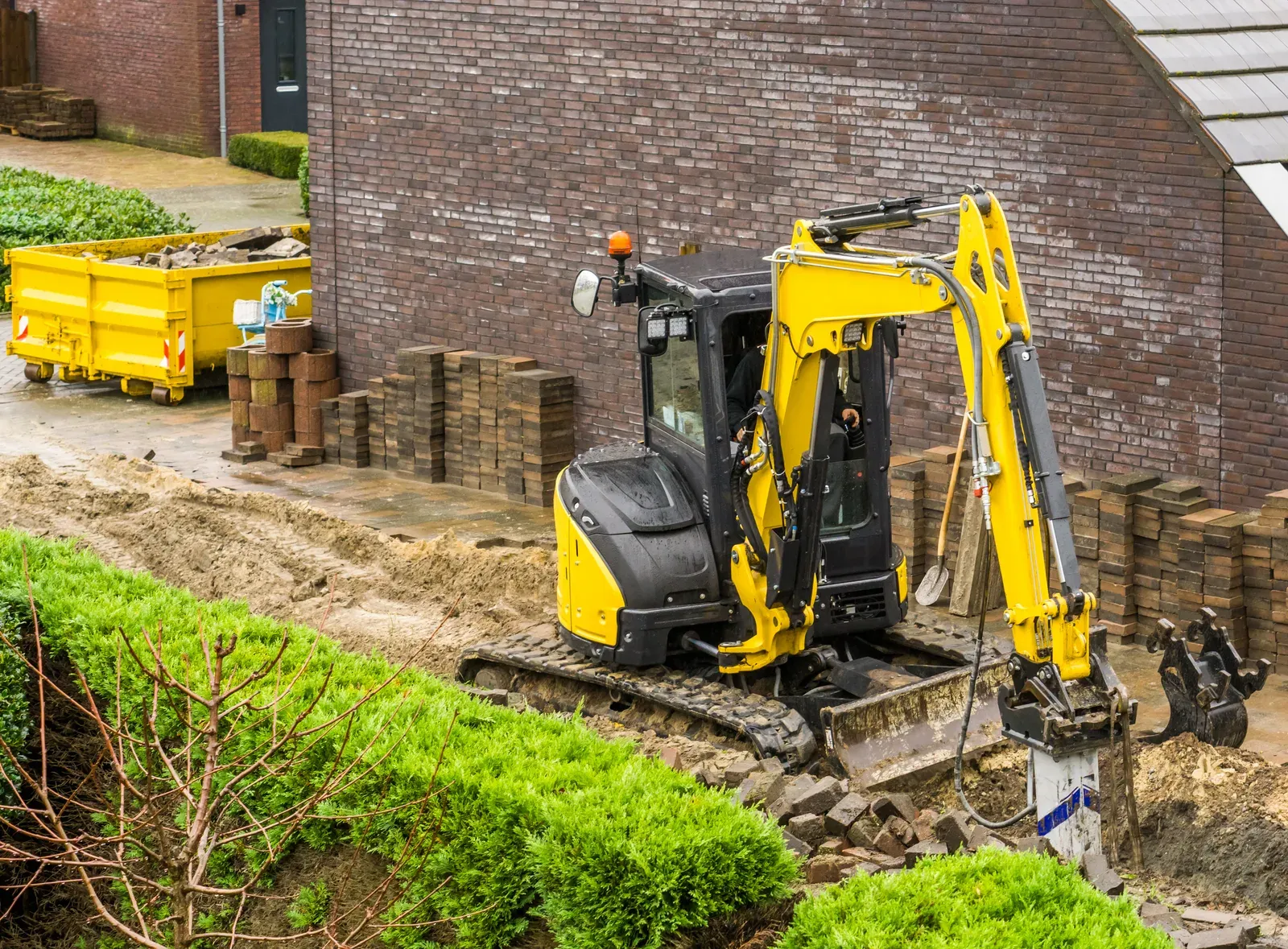
The core driver of servicing cost is simply how far the trench has to travel and how many services it carries. A combined trench for water, sanitary sewer, and electrical conduit commonly runs in the range of $200 to $350 per linear metre once excavation, bedding, pipe, conduit, and backfill are included. On a lot where the suite sits 15 metres from the main house, that puts servicing in the neighbourhood of $3,000 to $5,250; stretch the same trench to 40 metres, common on deep suburban lots, and the cost climbs toward $8,000 to $14,000 before accounting for obstacles. Anything that complicates the route, existing trees, a driveway that must be cut and restored, or utilities already buried in the path, adds further to that base figure, which is why an accurate route survey matters as much as the length itself.
200-Amp Panel Upgrades: A Common Add-On
Most GTA homes built decades ago carry 100-amp electrical service, which was adequate for the original house alone but often falls short once a second dwelling with its own kitchen, HVAC, and appliances is added. Upgrading to a 200-amp service, sometimes with a subpanel dedicated to the suite, typically costs $3,500 to $6,500 depending on the utility’s requirements and how much of the existing wiring needs to change to accommodate the larger service. This is worth confirming early, because an undersized panel discovered mid-project is a costly redesign that can also delay your electrical inspection, while the same upgrade planned into the original electrical scope is simply one more coordinated task for the same crew already on site.
Separate Metering vs Shared Service
You generally have two paths for how the suite draws water and power: shared service, where the suite runs off the main house’s existing meters, or separate metering, where the suite gets its own water and hydro accounts. Separate metering typically costs more upfront, since it requires its own service line and meter installation, but it gives a landlord clean, itemized utility billing for a tenant and avoids disputes over who is paying for what each month. Shared service is simpler and cheaper to install but means utility costs are folded into your own bills unless you build a cost-sharing arrangement directly into the lease. For a suite you plan to rent long-term, the modest upfront cost of separate metering is usually worth it for the administrative clarity alone, especially once a tenant moves in.
Sanitary Considerations: Backwater Valves and Capacity
Connecting a second dwelling to the municipal sanitary system sometimes triggers additional requirements beyond the pipe itself. Many municipalities require a backwater valve, a device that prevents sewage from backing up into the home during a municipal system surcharge, typically adding $1,500 to $3,000 when installed as part of new servicing. On older streets, the existing lateral connecting your property to the municipal main occasionally has limited capacity for a second unit, which a plumber or engineer can confirm during design rather than during excavation, when a surprise is far more disruptive. These checks are inexpensive relative to the cost of discovering a capacity problem after the suite is built and already occupied by a tenant.
Getting an Accurate Servicing Number Before You Budget
Because trench distance and site conditions drive so much of this cost, a generic servicing allowance in an early quote should be treated as a placeholder, not a promise you can rely on for financing. The reliable way to get a real number is a site walk that measures the actual distance from the main house’s connections to the proposed suite location, checks existing panel capacity, and flags trees or hardscape sitting in the likely trench path. That is exactly what our feasibility assessment does before we put a servicing figure into your budget, so the number you plan your financing around reflects your specific yard rather than an industry average pulled from someone else’s project.
Related Reading
Ready to plan your garden suite?
Our design-build team is here to help you bring your backyard home to life. Get a free, no-obligation quote today.
Get Free Quote