
Close, But Not in the House: Why Families Choose Backyard Suites Over Spare Bedrooms
Why more GTA families are choosing a backyard suite over the spare bedroom: the psychology of dignity and independence, real daily routines, and a commute that is thirty steps, not down the hall.
The Spare Bedroom Problem
The spare bedroom solves a housing problem and creates a family one. Moving a parent, an adult child, or a sibling into an existing bedroom collapses two households into one under a single roof, one kitchen schedule, one thermostat argument, one set of house rules that used to only apply to the people who grew up under them. It is not that families do not love each other enough to share a hallway; it is that adults, of any age, function best with a door of their own to close. A typical family tries the spare room first because it is free and immediate, and many find within a few months that the arrangement works logistically but wears on everyone emotionally: nobody quite has their own home anymore. That realization, more than any brochure, is usually what starts the conversation about a backyard suite, a second home on the same property rather than a room inside the first one.
What Thirty Steps Actually Buys
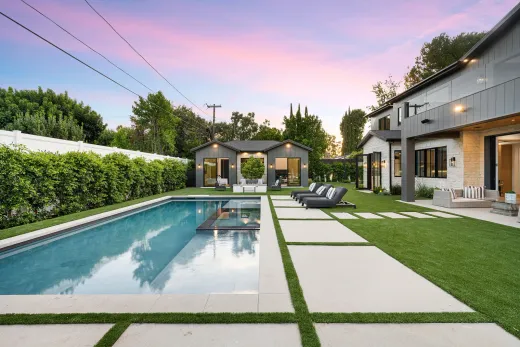
Thirty steps is roughly the walk from a typical GTA back door to a garden suite at the rear of the lot, and that short distance carries a lot of psychological weight. It is close enough for a daily check-in, a shared dinner, or grandchildren running between two kitchens, but far enough that each household has its own front door, its own kitchen, its own bathroom, and its own hours. Families describe the difference as the ability to hear a knock instead of footsteps in the hallway, to choose when to be together instead of defaulting to it because there is no alternative. A single-storey suite removes stairs from the equation entirely for anyone with mobility concerns, and a private outdoor space, even a small patio, gives each household somewhere to simply be alone outside without leaving the property. The distance is the feature, not the drawback.
A Day in Two Households, One Yard
Picture a typical multigenerational household after a garden suite is built: the parents in the main house get up, make coffee, and by nine a text goes to the suite, a plan for lunch together or a note that today is a quieter day. The suite's occupant, a parent, an adult child, or another relative, comes and goes through their own entrance without announcing it to the main house, keeps their own schedule, cooks their own meals most nights, and joins the main house for dinner two or three times a week by choice rather than necessity. Grandchildren treat the suite as a second home base, its own kind of exciting, without either household losing its ability to just be quiet on an ordinary Tuesday. That rhythm, chosen contact instead of constant proximity, is what families consistently say they could not replicate with a shared roof, no matter how large the house.
The Numbers Behind the Decision
A custom garden suite in the GTA typically runs $285,000 to $450,000 or more all-in, with prefab options starting around $225,000, and design and permits alone account for roughly $15,000 to $35,000 of that before construction begins. Compare that to the cost of an addition large enough to create a truly separate suite with its own entrance inside the existing house, which often runs comparably high once you add the disruption of living through construction, and the backyard suite starts to look less like an extravagance and more like the more livable option for the same money. If the suite will house a parent aged 65 or older, the refundable Multigenerational Home Renovation Tax Credit can return up to $7,500 on eligible costs, and Bill 23 exempts qualifying additional residential units from municipal development charges. None of that makes the decision purely financial, but it removes financial excuses from a quality-of-life decision.
Independence Both Ways
The independence argument runs in both directions, and families who skip the second direction often regret it. Yes, the parent or adult child in the suite gets a door of their own. But the household in the main house also gets its independence back: adult children raising their own kids without a well-meaning grandparent one wall away, a couple with an empty nest who do not have to negotiate every guest and every evening around a full-time housemate. Both generations report feeling more generous toward each other once proximity is a choice rather than a condition, and arguments about noise, schedules, and privacy that plague shared-roof arrangements mostly evaporate. A garden suite does not weaken the family bond by putting a wall between two households; in most cases it strengthens it, because nobody is quietly resentful about a boundary they never got to set.
Is It Right for Your Family?
A backyard suite is not automatically the right answer for every family, and it is worth being honest about when the spare room, or a nearby rental, actually makes more sense. If the arrangement is meant to be short, a few months while someone recovers or transitions, the cost and timeline of construction rarely pencil out. If your lot is too small, heavily treed, or has no realistic servicing route, that needs confirming before the emotional decision is made, not after. But for the large number of GTA families expecting a multi-year or permanent arrangement, the suite consistently outperforms the spare bedroom on the thing that matters most day to day, everyone getting to keep their own home. A free feasibility assessment is the fastest way to find out whether your yard can support one.
Related Reading
Ready to plan your garden suite?
Our design-build team is here to help you bring your backyard home to life. Get a free, no-obligation quote today.
Get Free Quote